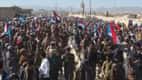





The city of Ataq, the capital of Shabwa Governorate, witnessed widespread security tension following protests called by local leaders affiliated with the Southern Transitional Council (STC) on the occasion of what is known as “Martyr’s Day,” alongside calls to renew the mandate for the council’s president, Aidarous Al-Zubaidi — a scene reflecting the continued strong presence of the southern issue in the political and social life of the governorate.
Security Measures and Field Escalation
According to local sources, security forces imposed strict measures from the early morning hours, closing roads leading to the protest square and preventing the gathering from taking place. Eyewitnesses reported that forces stormed the sit-in site and fired shots into the air to disperse demonstrators, creating tension and anger among protesters.
During the events, some protesters removed the Yemeni unity flag from the governorate building and raised the southern flag, a symbolic act carrying clear political implications. The situation later escalated into sporadic clashes between security forces and protesters around the square and nearby streets.
The clashes resulted — according to a preliminary toll — in the death of five protesters and injuries to 28 others with varying wounds, who were transferred to the city’s hospitals for treatment, while no official casualty figures have yet been issued by security authorities.
Meanwhile, the city is witnessing a heavy deployment of security forces across several neighborhoods amid public anxiety and anticipation.
A Deeper Political Background
The events in Ataq cannot be separated from the broader context of the southern issue in Yemen. Many residents of the southern governorates believe that the 1994 war and the political and administrative arrangements that followed led to increasing feelings of marginalization and loss of partnership in power and wealth.
Since 2007, a protest movement known as the Southern Movement (Al-Hirak Al-Janoubi) has emerged. Its demands initially focused on political and economic reforms but gradually evolved among wide segments into calls for restoring the former South Yemeni state.
Shabwa is considered one of the provinces where political and economic factors intersect, given its oil and gas resources, making it a sensitive point in any political equation concerning Yemen’s future and the shape of the state.
The Idea of Secession in Public Consciousness
In the southern street, the secession demand is not viewed merely as a political slogan. Supporters see it as a solution to accumulated crises — from weak basic services and lack of stability to recurring armed conflicts and the presence of multiple military forces. Many supporters of the STC argue that their project aims to establish an independent southern state that would, in their view, restore stability and local management of resources.
Conversely, other Yemeni political forces believe secession could deepen the crisis and threaten what remains of state institutions, calling instead for a comprehensive political settlement that guarantees genuine partnership among different components within a federal state or another consensual framework.
A City at a Crossroads
The events in Ataq reflect the fragility of the security and political situation in southern Yemen, where popular demands intersect with military and regional calculations. The protests are no longer merely symbolic activities linked to political occasions, but an indicator of a deeper struggle over the identity and future of the state.
With tensions persisting and no final political settlement in sight, Shabwa — along with the rest of the southern governorates — appears to be entering an open phase with multiple possibilities: either de-escalation through political dialogue that addresses southern demands, or further escalation that could once again place the southern question among the most prominent issues in Yemen’s ongoing crisis.
Security Measures and Field Escalation
According to local sources, security forces imposed strict measures from the early morning hours, closing roads leading to the protest square and preventing the gathering from taking place. Eyewitnesses reported that forces stormed the sit-in site and fired shots into the air to disperse demonstrators, creating tension and anger among protesters.
During the events, some protesters removed the Yemeni unity flag from the governorate building and raised the southern flag, a symbolic act carrying clear political implications. The situation later escalated into sporadic clashes between security forces and protesters around the square and nearby streets.
The clashes resulted — according to a preliminary toll — in the death of five protesters and injuries to 28 others with varying wounds, who were transferred to the city’s hospitals for treatment, while no official casualty figures have yet been issued by security authorities.
Meanwhile, the city is witnessing a heavy deployment of security forces across several neighborhoods amid public anxiety and anticipation.
A Deeper Political Background
The events in Ataq cannot be separated from the broader context of the southern issue in Yemen. Many residents of the southern governorates believe that the 1994 war and the political and administrative arrangements that followed led to increasing feelings of marginalization and loss of partnership in power and wealth.
Since 2007, a protest movement known as the Southern Movement (Al-Hirak Al-Janoubi) has emerged. Its demands initially focused on political and economic reforms but gradually evolved among wide segments into calls for restoring the former South Yemeni state.
Shabwa is considered one of the provinces where political and economic factors intersect, given its oil and gas resources, making it a sensitive point in any political equation concerning Yemen’s future and the shape of the state.
The Idea of Secession in Public Consciousness
In the southern street, the secession demand is not viewed merely as a political slogan. Supporters see it as a solution to accumulated crises — from weak basic services and lack of stability to recurring armed conflicts and the presence of multiple military forces. Many supporters of the STC argue that their project aims to establish an independent southern state that would, in their view, restore stability and local management of resources.
Conversely, other Yemeni political forces believe secession could deepen the crisis and threaten what remains of state institutions, calling instead for a comprehensive political settlement that guarantees genuine partnership among different components within a federal state or another consensual framework.
A City at a Crossroads
The events in Ataq reflect the fragility of the security and political situation in southern Yemen, where popular demands intersect with military and regional calculations. The protests are no longer merely symbolic activities linked to political occasions, but an indicator of a deeper struggle over the identity and future of the state.
With tensions persisting and no final political settlement in sight, Shabwa — along with the rest of the southern governorates — appears to be entering an open phase with multiple possibilities: either de-escalation through political dialogue that addresses southern demands, or further escalation that could once again place the southern question among the most prominent issues in Yemen’s ongoing crisis.